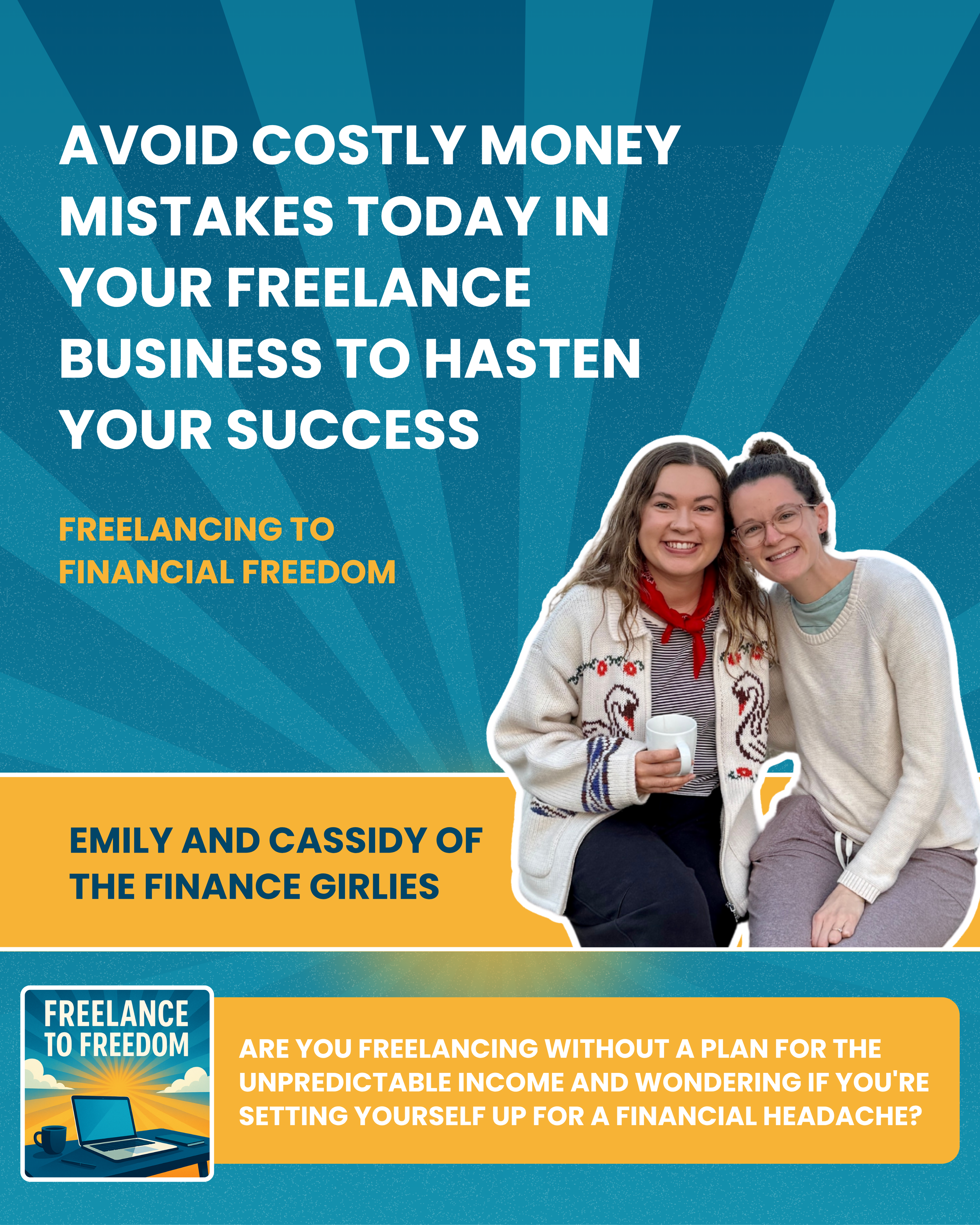
Avoid Costly Money Mistakes TODAY In Your Freelance Business to Hasten Your Success [ Freelancing to Financial Freedom ]
Make it stand out
Are you freelancing without a plan for the unpredictable income and wondering if you're setting yourself up for a financial headache?
Many freelancers enjoy the freedom of working for themselves, but that freedom often comes with financial uncertainty. From managing irregular income to figuring out taxes, health insurance, and retirement savings, it's easy to feel overwhelmed.
In this episode, I interview Emily Batdorf and Cassidy Horton of The Finance Girlies, and they share practical strategies that can help you build a more stable and sustainable freelance business.
By listening to this episode, you'll learn how to:
Avoid costly financial mistakes so that you can have peace of mind from day one.
Create a system for handling taxes, retirement savings, and health insurance with confidence.
Build a financial cushion and budget that helps you navigate income fluctuations and grow your freelance career sustainably.
Press play now to discover the financial systems and habits that can help you keep more of what you earn and create greater stability in your freelance business.
Socials: @thefinancegirlies (Instagram); LinkedIn: /cassidybhorton and /emilybatdorf
Connect with Kiri, the host:
Corporate2Contract
LinkedIn
Instagram
Reddit
Episode Transcript:
# Video Title: Avoid Costly Money Mistakes TODAY In Your Freelance Business to Hasten Your Success [ Freelancing to Financial Freedom ]
# Video URL: https://open.spotify.com/episode/1TvipSohNyosLPtHv7xcmX
# Transcript generated by SpotScribe - Extract transcripts from any podcast instantly at https://spotscribe.io
========================================
[00:00] Stay tuned for this episode to learn how to avoid costly money mistakes today in your freelance business so you can hasten your success. Welcome to the Freelance to Freedom Podcast. This podcast helps early freelancers learn how to get more clients with clear strategies that help your freelance business make more money in less time. I'm your host, Kerri Mohan, founder of Flourishing Freelancer. Let's dive in.
[00:22] By the end of this episode, you're going to find out how to avoid costly money mistakes you might be making in your early years of freelancing, the finances you need to be thinking about while working full time, and why emergency funds are so important in freelancing. Welcome back to the show, guys. I'm so excited today. I actually am doing an interview, and I feel like it's been it's gotta be
[00:45] over a year since I've done an interview. Hopefully, I'm not too rusty, but we have on the show today Emily Batdorf and Cassie Horton, and they are actually cohosts of the finance girlies podcast. This is super exciting for me, and I was telling them off the air that I have been wanting to do something on financing for freelancers for all of you for such a long time, but I don't know if
[01:07] it's a mindset or I just don't, like, feel like I'm an expert, but I I don't know. I struggle with giving a lot of, like, nitty gritty finance advice. So this is where the episode that you wanna listen to right now because we're gonna be diving deep into health insurance, regular income, emergency taxes, and it's gonna be amazing. Emily and Cassidy, both after years of freelance writing for finance brands like AOL,
[01:31] Yahoo Finance, and Forbes Advisor, they wanted to create a space where money conversations felt like sitting on the couch with a friend, which funnily, I don't think I actually talk about finances with my friends on the couch that much. We we're all in, like, different careers and sectors. But I really think you guys should check out their podcast, finance girlies. And if you wanna understand finances better and
[01:51] get a better control over them, that would be the place to start. So let's start off, Emily, with you. Tell me your story about how you started freelancing and what your journey has been like over the past seven ish years. After college, I took a job as an environmental educator, which was right in line with what I studied. I was an environmental studies major in college and education just
[02:13] felt really natural to me. I loved teaching and being outside and kind of being in that field science. But 2020 hit, the pandemic shut down my company, sent all educators home, and I kind of just had to start from scratch. It was the only job I had had out of college. I liked teaching, but teaching jobs were super weird during the pandemic and I wasn't
[02:45] sure I wanted to get into that and be doing this remote teaching. It sounded really difficult and I kind of just experimented for a while. I took a couple of part time jobs and did some volunteering. And during that time came across a freelance writing course. And what appealed to me was after losing my job during the pandemic, the idea
[03:13] of having control over my income and my schedule and my career was like, I wanted that so badly. I bought this course. It was the most I had ever spent on myself, I think ever in one single transaction. And so it felt really scary, but I was like, this is a pandemic. I have nothing to lose. Let's just go for it.
[03:37] And so kind of slowly and steadily built that business up over the next few years while I had a part time job during some of that time. And the course I was in encouraged you to choose a niche for your writing business and personal finance felt really natural to me. It was something I enjoyed learning about. Wait. I wanna I wanna just jump on that for second.
[04:02] Why did it feel natural to you? Because you'd been in environmental studies. So, like, that I I'm an environmental studies major as well. I specialize in urology, so we have something similar. I would never be a teacher, though. No. No. Thank you. But, like, that I'm still like finances. I'm pretty good at them, but I wouldn't be like, yes.
[04:20] That's the niche I'm gonna go into. My Yeah. Yeah. No. Good question. So when I was working my job in environmental studies, I was making $30,000 a year. That's an important point. And living in a really expensive area. And so just kind of by necessity, I got really into personal finance. It was like reading all the books, listening to all the podcasts.
[04:44] And it became something that I literally would talk about with my friends. My husband, we were dating at the time. He got really into it too and it was something that we enjoyed learning about. And so back to when I started freelancing, the advice that I got and Kasti got to was choose a topic you enjoy learning about and enjoy talking about because you're gonna you're gonna go deep into
[05:14] that topic and you wanna stay interested. So that's how I landed there. Okay. That's good to know. And I like that. I like that advice because if you're gonna be marketing yourself and you're gonna be writing about it and you're gonna be do like, you better really enjoy what you're talking about. Right? And we do have another similar thing. Like, when I started out, I was
[05:34] not making 30,000. I was making 38,000, I think, as an executive assistant. And that was oh god. I don't even wanna age myself. So that was about sixteen years ago. So I would would have been making more than you even with inflation. But Mhmm. We live in a very expensive area of Massachusetts, and now it was like same thing. It was like, okay.
[05:54] Well, if we're gonna get out of this little tiny apartment eventually, we need to start saving. Even with both our incomes being really low, how do we do that? And I always say to my husband now, like, I got us to where we need to be. Like, buying our houses, we've gotten to so far. And it's like, I saved our money. I got us where I need to be
[06:14] by being super diligent, knowing where to spend, knowing where to save. My husband has now taken us further because he's the one that's really interested in investing, and he's the one that's, like, grown our income so much. But it's like, I took us to a certain point, now he's taking us to the next level. But I I remember those days of saving and learn reading tons
[06:33] of personal finance books and taking some information from here, other information from there, and just kind of compiling it into something that worked for our family. Cassidy, tell me a little bit about your story of freelancing and what your journey has also been like. Yeah. So I just for a little bit of context, I'm originally from Georgia, and I grew up in one of the poorest counties in Georgia.
[06:57] And so I feel like growing up, I always saw my family struggle with money in different ways. And so I think from a very early age, I was like, I'm gonna try my best to do things differently. So I know you had asked Emily like, why? Why were you personally interested in personal finance? Think from as long as I can remember back, I've always had some small interest
[07:19] in personal finance, which will be important later on. So yeah, I went to college had absolutely no idea what degrees I wanted to get. Ended up getting a bachelor's in public relations, didn't know what I wanted to do with that. Then I got an MBA, so a master's in business administration. And I was like, this feels so random. I have like a PR degree and
[07:39] a business degree. I don't know what I'm doing. I still don't know what I want to do for a job. So similar to you all, my first job out of college paid $32,000 a year. And I was working as an academic advisor at my university. So I stuck around there did that for almost two years. And I learned during that time truly how little $32,000 stretches even when you're living
[08:05] in a very low cost of living area. And so I also at the time was like, I want to leave Georgia as soon as I can, not for any particular reason. But I was like, I want to experience a different part of the country, like, you know, like, want to grow in all of these personal ways. And I feel like living in a different part of the country will be good
[08:23] for me. So anyway, I two years into academic advising was like, I know that I want to move to Seattle, that is my goal. I don't think I want to be an academic advisor when I moved there. And so I just began to think really outside of the box about what I would want to do. And around that same time, I also got an Instagram ad
[08:43] for this copywriting course that Emily had talked about. I had never heard of copywriting before, but I was like, you know what, I am willing to try anything. And it was also the most money I'd ever spent on anything. But I was like, you guys keep saying that, like, how much was this course? So I bought the course in December 2018, and it was $997 at the time,
[09:07] which fell for a 24 year old. Fresh out of brand school. I mean That's huge. That's huge. And even nowadays, that number is still big. When you have no guarantee of ROI, a return on investment, right, you're like, am I even gonna succeed in this, or is this gonna be something I take? And I'm like, oh, no. Never mind. Don't wanna be a copywriter.
[09:26] Right? That's a big amount of money. I know. And, also, at the time, I did not know anyone who owned a business, especially an online business. And then also, like, I didn't really know the concept of, like, investing in a course to like teach you a skill outside of college. So I was like, Am I gonna get scammed? You know, you're just like, I
[09:45] don't, I don't know what's gonna happen. I don't even really understand what freelancing is. I This just feels right. So I'm just gonna go for it. And we'll see what happens. So I started going through the course ended up moving to Seattle two months later, and got my first client like within a week of living there. Yeah. And then like, my initial goal with freelancing, I was like, my
[10:08] only goal is to replace my $32,000 salary. Because truthfully, I was like the the idea of making $32,000 on my own outside of an employer hiring me and agreeing to pay me that much felt like a wild concept, you know, so I'm like, if I make $32,000 on my own, like, that's going to be amazing. But I think my first year, even when I got my first client, in March,
[10:32] I ended up making like $45,000 that first year, which when your base is $32,000, I was like, oh my god. We're making it. We're doing it. Isn't that amazing? I think so many of us freelancers start like that. Like, I was like once I decided to really make it my career, I was like, okay. If I can make I think it was, like, 60,000 for me.
[10:52] I was like, that will make me feel good. And I was that what I was making? I think it was yeah. I think it was. Oh, yeah. It was. Because when I gave my notice, they offered me 80,000 to stay. And I remember being like, what am I doing? But then I remember thinking like, well, maybe I can make a little bit more
[11:09] with this, and then I don't have to worry about that. And then, of course, I went on to make much more. But I think for me in the beginning, when I first started looking freelancing as a career, was like, well, if I decide to have kids, maybe it can be just so that I don't have to do childcare, and I can work a little
[11:21] bit on the side. And then maybe it'll cover, like, classes and groceries as well. And then it started being like, well, what if I could actually make it match my salary and not work as much as, like, eight to five or 08:30 to 05:30 like I am? Mhmm. And then it just kept going and going. And it's a great feeling. And I think a lot of us start start like
[11:37] that, you know, and just saying that if I could just make this much, I'll be happy. Mhmm. I know. I remember even, like, thinking when I had my first $5,000 month, like, I can't imagine making $5,000 in one month, you know. It's just all of those your your idea of what you think is possible for you is one based on whatever probably full time job you're leaving.
[12:02] But also, it's so small in comparison to, like, what it can actually What it can be be. Grow to. Yeah. That kind of pulls me into a lot of the listeners of this are either working full time right now and looking at investing into freelancing, building it as a business. Some of them have already left and jumped into freelancing. They're in their early stages. But for those that are, you know, still
[12:25] working, how do you set up your finances to feel comfortable to make that leap? And I I think I was even talking to a potential student yesterday, and that was her biggest struggle. She was like, it seems like a lot of work while I'm working full time to also be building the freelance business. Like, when do I know it's time to make the leap, etcetera, etcetera?
[12:43] So how do you build up your finances to that point? Yep. Maybe we can tag team this a little. I'll start by saying, I don't have the experience of working full time while building my freelance business. So my advice is going to be a little bit skewed, I'll say. But I think the very first thing, as soon as you're, and we don't have
[13:07] to get into the tactics so much right now, but the very first thing once you're starting to earn money from a freelance business is to set up a separate bank account for your business just so you can keep everything straight. So how much you're earning, what your expenses are. And then I would say if you're earning a full time salary, just start saving your earnings in your freelance business.
[13:37] Keep really good records of how much you're earning and set a goal of, okay, if I can make this much money in a month, I will feel secure. I can pay my bills, I can cover. Maybe it is matching your full time salary. Maybe you don't need that much, maybe it's a little less or maybe it's more. And then see if you can, like, hit that number a few months in
[14:07] a row and, like, consistently show yourself you can earn that much while building up kinda like a what Cassidy and I call a cash cushion. So you can start off your freelance business when you do decide to go full time with a healthy cushion that you can fall back on if say you do have a slower month because as we all know, that does happen.
[14:31] Yeah. So I remember once getting advice from my acupuncturist crazily. I was, like, you know, building my freelance business, and she said, just save all that income. You have a full time job. Save it all. And then you have that in there just in case things go wrong. And I was like, what? Because I had been, like, paying myself.
[14:48] Because I've been online reading about, like, freelancing, and everyone was like, make sure you pay yourself. Don't stress yourself out too much. And I didn't think that I had a full time job. Like, so I I don't need to pay myself. Right? But that is I I put that away. And, actually, I don't know if you guys agree with this, but, like, the student in my group right now who
[15:07] is thinking of quitting his full time job is very close. He was asking me, like, my rule of thumb. And one of the things I did say was consistency. And he has, like, one retainer, maybe two, and he's got project work coming in, but it's all very new. Some of the contracts haven't been signed yet. So I told him, for me, I like to see when I'm advising
[15:25] people because this is our livelihood, two thirds of your income at least consistently month to month of your full time income. Because then once you quit, you have those eight hours to go after more clients and hopefully make up that other third. But I said two thirds of that income and then at least two or three months of consistent, I guess, project work coming in. Because for him, it was, like,
[15:46] two like, the the retainer and the project work. And I said the project work, since that's so up and down, let's make sure that we can get two to three months of these people consistently sending you projects. It was copywriting as well. So that was kind of kind of not even kind of. That is what I told him to do. Still TBD on that.
[16:04] We'll see. He's in the process right now. Cassidy, do you have any advice on what people should do for setting up their finances in order to to feel comfortable jumping into freelancing? Yeah. I this is gonna sound like a canned answer, but I think anytime that you can have a pool of money on your side, whenever you're building a freelance business is good, like whether you have an emergency fund, or whether
[16:28] you are like taking all the money that you're earning in your freelance business, and then not using it, I think anytime you have cash reserves to fall back on, it just gives you so much more breathing room to actually decide like, okay, if I do quit my job, and for whatever reason, my freelance business is not continue like how I think it is, will I have enough money to like, give me
[16:49] a little leeway to figure out a game plan to pitch harder to pivot to do all of the things. And so I think a lot of peace of mind comes from that specifically. But a more like actionable piece of advice that I would have. Emily and I actually have a friend, she's another freelance writer. When I met her, she was an English professor at a university.
[17:10] And she was building her freelance business on the side. And as her freelance business grew, she knocked back how many classes she was teaching every semester. And then she eventually still got to the point where she was like, I'm having to turn down freelance writing work because I don't have time with my like full time job to continue taking on these projects.
[17:31] And so that for her was like her personal sign of I can make so much more money freelancing, but I'm not able to, because of my full time job. And so I think to depending on your situation, if you find yourself where you're like, I'm having to say no to projects that I would really wanna take on because my freelance because my full time job is getting in the way.
[17:50] Like, that could also be a sign of, are you ready to make the leap or not? Yeah. I think that's great advice. I remember looking at my phone, and it kept blowing up over this, like, two week period. Like, people one of the clients I had, I had to give my number out, and they just kept call like, people were calling his clients.
[18:07] And I was like, you know what? This is getting ridiculous. Like, I can't give the client the attention I need. And then weirdly, I ended up signing a client during, like, that weird two to four week stretch where I was starting to stress out that his company required sending a laptop to me. They wouldn't let me use my own laptop.
[18:24] They're very like, they're more on the corporate side and had, like, a lot of rules and regulations. And I was like, Welsh, this means I have to, like, make a decision. I was almost, like, forced into a decision there. But for me, there was that. Like, I kept seeing the phone go off during work, and I was like, oh god. Like, that's a client client that I'm not
[18:43] able to answer to. Let's talk about these first few years of freelancing. What do you see as the biggest money mistake freelancers make in those first few years? I think and I already hinted at this. I think the biggest mistake is not setting up a separate system for your business finances. So having a separate bank account, having a system for how you pay yourself, setting
[19:12] aside money for taxes, like I think all of that kind of fits into this greater category of just not having a separate plan. Because once your business earnings start intermingling with your personal money, it just gets really, really messy. So, Kesta, you wanna add to that? Yeah. Before I ever earned a penny, I'd opened a business bank account, like a business checking account, and I don't know if
[19:38] you did that as well. Mhmm. But, yeah, having a separate thing for your money to go into is like one of the most actionable things that you can do. But beyond that, I do think yeah, setting aside money for taxes. I think so many times like, if you're freelancing, especially in the beginning, like you truthfully, you might need every single penny that you're earning, which is kind of the
[20:01] unfortunate reality, like my very first, my very first month of earning freelance income ever, I made $120 So and I do remember the happy dance that I did in my bedroom, which is where my office was at the time, because I had like officially made money on my own. But I do think setting aside from the beginning, 30% of every single dollar that you make and just pretending like it's not even
[20:25] yours and earmarking that because especially when you're just starting out, you don't actually know how your taxes are going to shake out and whether 30% will be too much that you're saving or not enough. And you will figure that out with time like I slowly figured out with time that maybe 20 or 25% was like a better percentage of me for me to set aside for my taxes.
[20:44] But I learned that over time, when my tax cushion was like way bigger than it needed to be, you know, and then I felt like I could take that extra money and open a retirement account or something like that, because I had accidentally been saving more than I needed to. So it ended up being an okay, little thing to work out. But I do think that that is the biggest one.
[21:06] And also just as your as your income continues to grow, which I think that it will and I hope that it explodes and I hope that you are surprised at how quickly your freelance business takes off. But really just try to focus on especially in those early years when you don't have the proof that that income will be there consistently for years and years and years, which in reality, a lot of
[21:27] times it doesn't our freelance businesses wax and wane. And there's kind of like a roller coaster. And that's just part of the journey. But really, in your high income earning months, trying to, like, save as much of that extra money as you can for the times that end up being a little bit leaner. That's one of the best things I think that I ever did for myself in
[21:47] those early years was not inflating my lifestyle as soon as my income increased. And I had, like, my first ten k month and my first fifteen k month and my first 20 k month. But instead being like, I'm going to continue living on my same amount of income. And I'm just going to set all this money aside. Because the reality is a few years later, I started having three ks months
[22:08] and twenty five hundred dollars months, because things kind of dried back up. And in those moments, I was like, I'm so glad that that early on Cassidy, like, whenever she was making bank and doing really great, like, set this money aside, because now I feel like even though my freelance business, you know, is hitting on the slow period, I can like breathe a little bit, and it's fine, and I
[22:27] don't have to worry so much. So really just thinking about future you and not thinking about anything, like, consistently being there forever Yeah. Is, I think, really the key. I agree with that. And I wanna add. So some business bank accounts for our listeners do charge a fee. However, I have found, and this is true for my students as well, when they talk to local banks, sometimes they will waive that fee
[22:53] or they will just not they'll have business bank accounts free if you make under a certain amount per year. I think my local bank is like if you make under 500,000 a year, you can get a business bank account for free. And when you're there at the bank, setting up your bank account, ask them if you could also set up a savings account. Because sometimes some banks make it easy.
[23:13] Sometimes banks make it like you have to sign all this paperwork. And then what you do is at least what I learned from a peer, which was so helpful, is just take that money every month and siphon it into that savings account. And then when taxes come around, you can just use that, but it's, like, out of sight, out of mind. It goes into that savings account, and then
[23:30] you don't even think about it. And I actually also do this for my SEP IRA. Now I have another so I have my normal business bank account, and then I have two savings account, one for taxes and one for SEP, and it just takes that percentage and puts it in there, which is really helpful. And for those listeners, in the show notes, there is my money mapper.
[23:47] So if you want to actually play with a spreadsheet and put in numbers, all formulas are there, and it will automatically show you how much you need to put away for taxes and how much you need to put away for SEP if you wanna go that far. Thank you so much for joining me in part one of my interview with the finance girlies, Emily and Cassidy. If you wanna know more about
[24:05] them, head to our show notes or go to the financegirlies.com. They have a quiz for you to find out what type of finance girly you are. Next week, we'll be going into part two, and we're gonna be starting to talk about retirement planning, health insurance, and, of course, the healthy business habits that you need to be aware of with your finances for your freelance business.
[24:24] As always, keep flourishing, and I'll see you here next week for part two with the finance girls. Are you struggling to get the income you desire as a freelancer? Download my money mapper for a clear view of the earnings you need to achieve your dream salary. It calculates monthly income while factoring in taxes, expenses, and the best part is that it grows with your business to include contractors and a SEP IRA.
[24:50] Head to the link in my show notes to calculate what you should be earning to start increasing your income.